
You’ve invested time and care into making your localised content accurate, relevant, and aligned with your brand but are the right people actually finding it?
In more and more projects, we’re seeing a shift: companies are connecting localisation efforts with international visibility goals, not just translating content, but making sure it performs in search. That’s where multilingual SEO comes in. Done right, it helps your content win in-market without changing your entire localisation process.
Why direct translations kill keyword strategy
Most localisation pipelines are built to move fast: launch the product, translate the copy, stay on schedule. Accuracy and tone get attention but visibility often comes much later, if at all.
Search behavior differs drastically by region. A keyword that drives traffic in Germany may flop in Spain. Word-for-word keyword translations, meta descriptions, or headers often result in zero visibility, even if the content itself is flawless.
That’s why simply “translating your SEO” doesn’t work.
What multilingual SEO really involves
Multilingual SEO means making content discoverable, aligned with local search behavior, and structured for the way people search in each language. That often means adjusting more than just the words on the page. From metadata to phrasing, from headers to local terminology, each detail plays a role in whether your content gets seen or stays hidden.
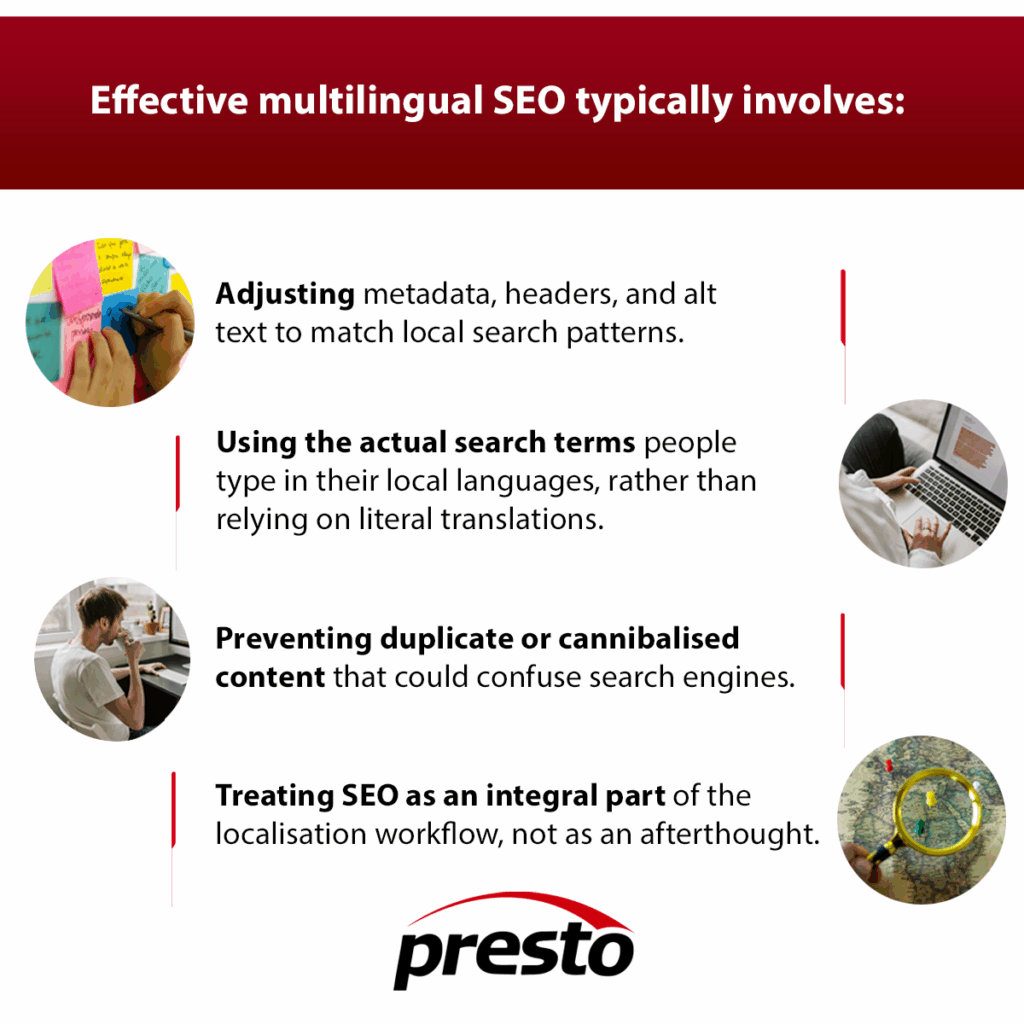
Common traps we see (and fix)
Here are three typical multilingual SEO traps we help clients avoid:
- Keyword mismatch: Translating “data privacy policy” directly may miss the phrase people in Italy actually search for.
- Broken structure: Copying English page layout without adapting French headers or metadata loses key SEO signals.
- Content cannibalisation: Multiple “similar” versions of pages across markets compete against each other and hurt rankings.
Fixing these issues early (or retrofitting them smartly) saves you time, money, and visibility.
Quick Checklist for Localisation Teams
If you want a fast health check, ask yourself:
- Have we tested our search terms in local language with actual volume data?
- Is our metadata localised or just translated?
- Do our H1/H2 headers reflect how local buyers search?
- Are our supporting assets (alt text, FAQs, internal links) adapted to local SEO patterns?
How PRESTO helps you rank smarter
We integrate multilingual SEO directly into the localisation workflow:
- Identifying local search terms that align with your business goals.
- Adjusting translations to meet SEO best practices per region.
- Coordinating with your internal SEO or marketing teams for seamless rollout.
- Auditing your existing localised content to uncover missed opportunities.
Do you want to know how your content is really performing in search?
Ask us for a free multilingual SEO audit. It’s quick, practical, and tailored to your goals so you stop leaking visibility and start turning localised content into measurable growth.